Robin Chan
Robin Shing Moon Chan is a PhD candidate in Computer Science at ETH Zürich. His research focuses on understanding linguistic user behavior during LLM-assisted task solving and designing interactive algorithms and systems that effectively support such human–LM collaboration.
His work has been recently recognized with a CHI Best Paper Award. He has previously co-organized a tutorial workshop at ACL attended by 100+ NLP researchers.
Affiliation: Department of Computer Science, ETH Zürich.
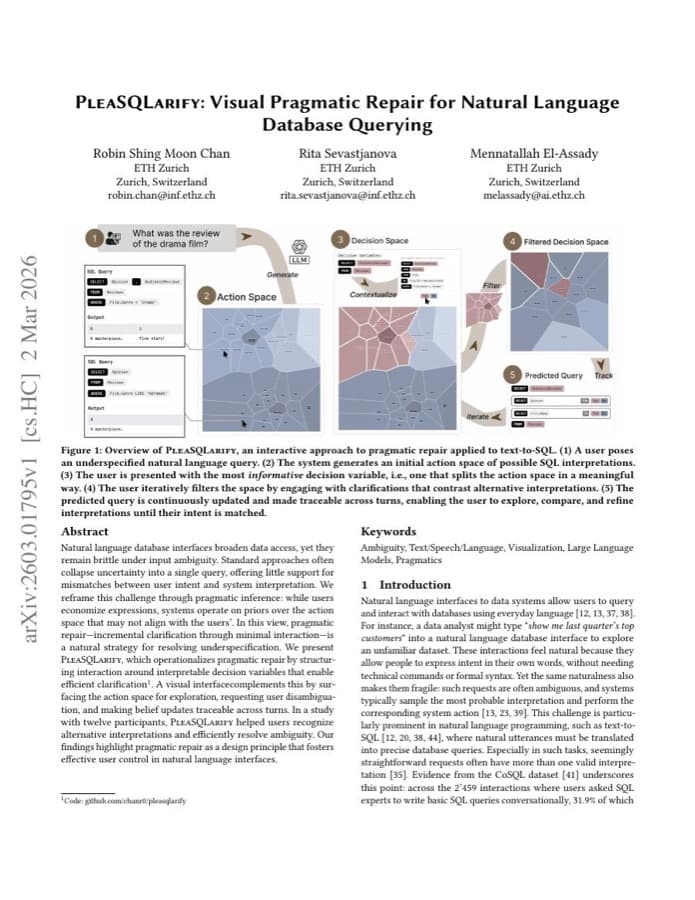
PleaSQLarify: Visual Pragmatic Repair for Natural Language Database Querying
Robin Chan, Rita Sevastjanova, Menna El-Assady
Proceedings of the 2026 CHI Conference on Human Factors in Computing Systems
Natural language database interfaces broaden data access, yet they remain brittle under input ambiguity. Standard approaches often collapse uncertainty into a single query, offering little support for mismatches between user intent and system interpretation. We reframe this challenge through pragmatic inference: while users economize expressions, systems operate on priors over the action space that may not align with the users'. In this view, pragmatic repair -- incremental clarification through minimal interaction -- is a natural strategy for resolving underspecification. We present PleaSQLarify, which operationalizes pragmatic repair by structuring interaction around interpretable decision variables that enable efficient clarification. A visual interface complements this by surfacing the action space for exploration, requesting user disambiguation, and making belief updates traceable across turns. In a study with twelve participants, PleaSQLarify helped users recognize alternative interpretations and efficiently resolve ambiguity. Our findings highlight pragmatic repair as a design principle that fosters effective user control in natural language interfaces.