
Prerna Ravi
Prerna Ravi is a PhD student at MIT's Computer Science and Artificial Intelligence Laboratory (CSAIL). Her research focuses on designing generative AI agents that augment team collaboration in education, creative practice, and collective decision-making. She has studied how users' mental models of conversational AI evolve over time, and how they both shape and are shaped by perceptions of the agent's trustworthiness, agency, and anthropomorphism.
Her research has been recognized with the Best Paper Honorable Mention and Nomination awards at ACM CHI and Learning at Scale. Prerna was the main organizer for a tutorial workshop at the International Society of Learning Sciences (ISLS) in 2023.
Affiliation: MIT Computer Science and Artificial Intelligence Laboratory (CSAIL).
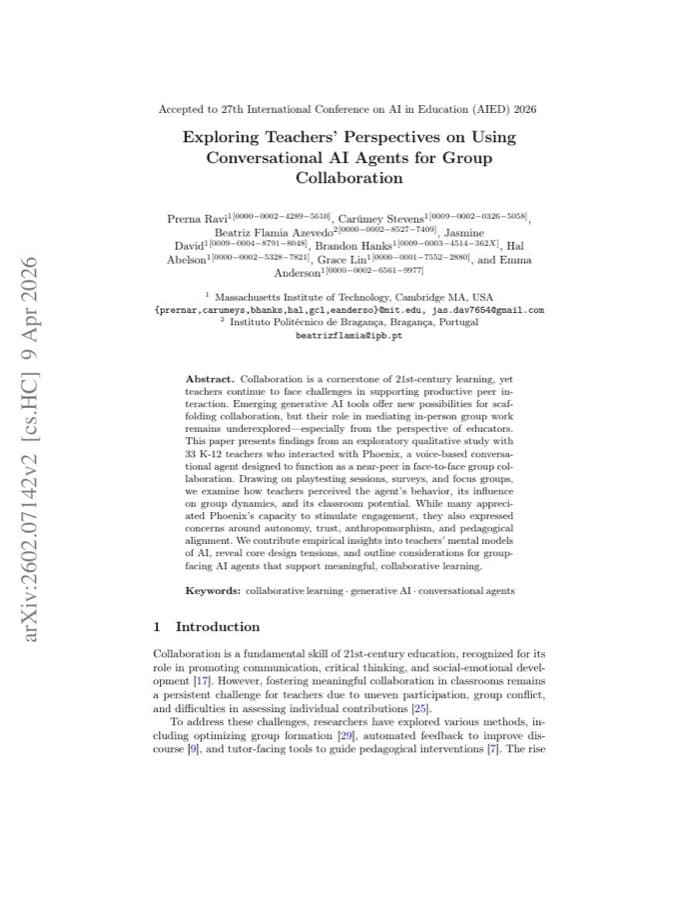
Exploring Teachers’ Perspectives on Using Conversational AI Agents for Group Collaboration
Prerna Ravi, Carúmey Stevens, Beatriz Flamia Azevedo, Jasmine David, Brandon Hanks, Hal Abelson, Grace C. Lin, Emma Anderson
Proceedings of the 27th International Conference on Artificial Intelligence in Education (AIED 2026), LNCS vol. 16584, Springer
Collaboration is a cornerstone of 21st-century learning, yet teachers continue to face challenges in supporting productive peer interaction. Emerging generative AI tools offer new possibilities for scaffolding collaboration, but their role in mediating in-person group work remains underexplored, especially from the perspective of educators. This paper presents findings from an exploratory qualitative study with 33 K12 teachers who interacted with Phoenix, a voice-based conversational agent designed to function as a near-peer in face-to-face group collaboration. Drawing on playtesting sessions, surveys, and focus groups, we examine how teachers perceived the agent's behavior, its influence on group dynamics, and its classroom potential. While many appreciated Phoenix's capacity to stimulate engagement, they also expressed concerns around autonomy, trust, anthropomorphism, and pedagogical alignment. We contribute empirical insights into teachers' mental models of AI, reveal core design tensions, and outline considerations for group-facing AI agents that support meaningful, collaborative learning.